Tuesday, September 3, 2019

Titus 1:1-9 Setting a High Bar

"5I left you behind in Crete for this reason, so that you should put in order what remained to be done, and should appoint elders in every town, as I directed you: 6someone who is blameless, married only once, whose children are believers, not accused of debauchery and not rebellious. 7For a bishop, as God's steward, must be blameless; he must not be arrogant or quick-tempered or addicted to wine or violent or greedy for gain; 8but he must be hospitable, a lover of goodness, prudent, upright, devout, and self-controlled. 9He must have a firm grasp of the word that is trustworthy in accordance with the teaching, so that he may be able both to preach with sound doctrine and to refute those who contradict it."

Observation: Paul is writing to Titus, his associate in Crete, whom he has tasked with appointing leaders for the church in nearby towns. Paul's standards for conduct for elders and bishops are very, very high. 

Application: When I read words like "blameless," "prudent, upright, devout and self-controlled," it's intimidating. The sobering truth is that, especially in today's culture, it can take hundreds of good interactions with a Christian leader to counter one bad impression in a person's mind. And because the church itself has been guilty of routinely and systematically covering up abuse and protecting abusers, I know my honor and the honor of all Christ-believers, and to some extent even Christ himself, is on the line when I go to work each morning. It's a lot sometimes.

But today, on the first day of school, as I rose early, dropped my kids at the bus stop, and got started on a brand new hopeful routine, I am reminded: yes, God's standards are high, but God's mercy is new every morning. I will continue to hold myself and other leaders to high standards. But knowing that, in a hundred small ways, we will fall short each day, I hope to also embody the grace we get from God. I don't want to just be known as "devout and self-controlled." I also want to be known as a person who gets God's grace, and will freely announce it to my fellow imperfect people. 

Prayer: God, help me do this one day at a time. Keep watch over my mind, my mouth, my hands and feet. Let me be a good ambassador for you. Amen.


Tuesday, August 13, 2019

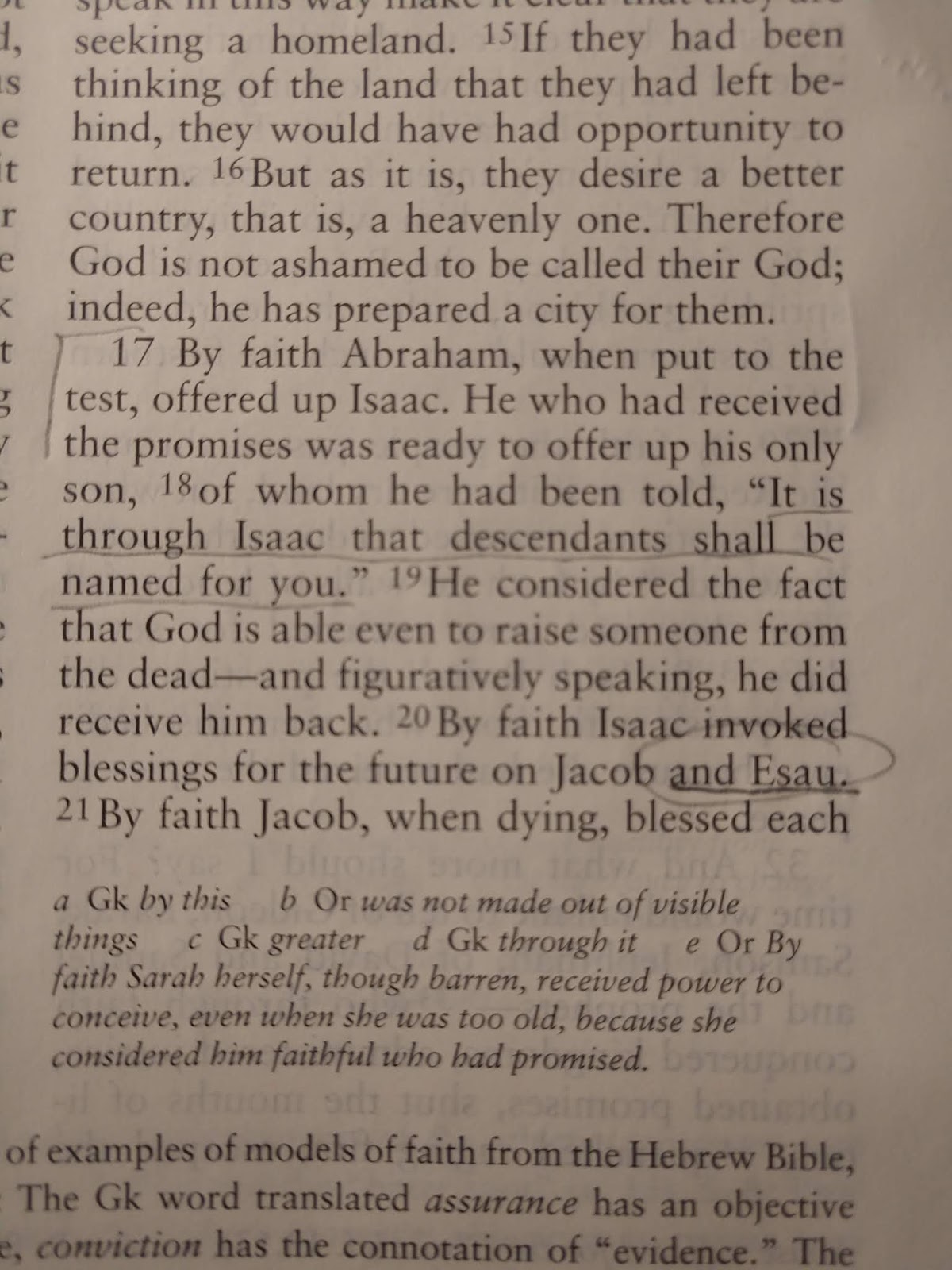
Hebrews 11:17-28 Faith Is...


Observation: The sermon in Hebrews recounts example after example of what faith looks like in the lives of people in the Hebrew Bible: Abraham, Isaac, Jacob, Joseph and Moses. Important note: it always involves taking action. Even Abraham, whom God has asked to sacrifice Isaac, his only son, trusts enough in God's promise, "It is through Isaac that descendants shall be named after you," that Abraham goes forward, believing that God will provide a solution. I'm also drawn to the words about Moses, who was raised by Pharaoh's daughter, and in theory, could have lived in privilege all his days, yet instead took the side of God's people against the most powerful nation the world had ever known.  

Application: Something that seems to hold all these examples together: Faith is always about making choices. Not just one choice, but repeated choices. And those choices do not make sense unless God is good. It reminded me of Martin Luther's quote, "faith is a living, daring confidence in God's grace, so sure and certain that a man could stake his life on it a thousand times." 

We've got the wrong idea about faith a lot of the time. Faith isn't about checking off boxes of very extraordinary or unlikely Biblical events, and whether we can intellectually assert that they historically took place. And faith doesn't mean following religious rules for fear of punishment, and excluding all the right people to keep ourselves morally pure. Neither of those definitions of faith are any use to God or the neighbor God asks us to serve. That's not what faith looked like for Abraham, Isaac, Jacob, Joseph, or Moses. 

Instead, faith is living. Faith is daring. Faith is not just in God, but in God's grace. Faith is waking up each day, and making choices that would make no sense if God were not good. Speaking up for those with no earthly clout of power. Rejecting comfort in favor of doing hard work on ourselves. Listening when we would rather get defensive. Advocating when we would rather be silent. Speaking out and doing the right thing when we know ahead of time we'll be called naive or even ignorant. 

If God were not good, none of these choices would make sense. If God were not good, we would have to spend all our time and energy defending ourselves, our property, our reputations, our little fleeting bit of happiness in a meaningless existence. But since God is good, we err on the side of grace, for the world, for each other and for ourselves. 

Prayer: God, you are good. Help me live like it today. Amen. 


Friday, August 9, 2019

Acts 7:1-8 "If You Knew Then What You Know Now...?"


Observation: After being accused of speaking against the Temple and Jewish religious laws in Jerusalem, Stephen, a Jewish Christian, begins telling the whole story of God's people, beginning with Abraham. What I notice about Stephen's retelling is a small detail not mentioned in the book of Genesis. In both versions, God promises the land that will become Israel to Abraham and his descendants, but in Stephen's version, God also forewarns Abraham that his descendants will spend four hundred years as resident aliens and slaves in Egypt before they return to inherit the Promised Land. Wow. Kind of makes me wonder whether hearing about this part of the story would make Abraham doubtful about making a covenant with God. Even though there is the promise that they will eventually dwell as free people in the land, that's a pretty dark cloud on the horizon. 

Application: A common question I think about when looking back on my life is, "If I had known a few years ago what I know now, would I have made the same choices?" Especially when we look back on difficult times in our lives, it's hard not to speculate. Are we better off for having gone through the trails we never could have predicted? Is it really true that "whatever doesn't kill us makes us stronger"? 

I'm of two minds on this. On the one hand, I think it can be really harmful, especially when someone has gone through something traumatic, to tell them, "It was all part of God's plan. It had to be this way." That discounts the pain and brokenness too many people experience. I would never dream of telling someone who has experienced something like domestic violence, sexual assault, murder, family separation, or other trauma that this was somehow destined or necessary. I could never worship a God who would intentionally put us through things like that.

On the other hand, I do believe in the theology of the cross, which tells us that God's presence can be found and experienced profoundly even in the depths of our pain and suffering. The Christian community is formed and marked by a symbol of God's entering into even the worst moments of human cruelty and showing love for us there. I do not believe every bad thing that happens is a necessary part of our story, but I do believe that because our world is twisted and fallen, and bad things do happen, God can turn those bad things into instruments of healing. Even though there was nothing "necessary" about the Israelites' period of slavery in Egypt, God did use that period of slavery to mark God's people with compassion forever, and codify that compassion into religious law, that they are never to mistreat foreigners in their own land the way they were mistreated. 

No trauma should ever be viewed as necessary, and no evil and injustice should ever be seen as inevitable. To say it ever is only opens the door to justifying horrific atrocities. But since we can't go back and change the past, God's healing touch can transform our stories and our souls, to allow for healing, justice and compassion in the future.

Prayer: God, transform our stories. Bring healing from that which is broken, and give us repentance so that which is healed may not be broken yet again. Amen.      


Tuesday, August 6, 2019

Psalm 127 Words of Blessing that Sting


Trying (unsuccessfully) to adapt a different morning routine in the summer, with travel, vacation, kids at home in the mornings, later nights, etc. Devotions have suffered. But by golly, I'm going to keep at it.

Observation: One thing I note here is that I had forgotten the first half of the psalm--"unless the Lord builds the house"--and the second half, about sons being "arrows in the quiver" of a father, were part of the same psalm. Taking them together reminds me that not only does God help us with physical building projects, but with the much more difficult "building" we do, of family relationships.

Application: I noticed today, as I was leaving for work in the midst of the chaos of having four kids at home, each with their individual needs, quirks, and mini-crises, that I actually apologized to my wife as I set out for work. We are definitely feeling the late summer burn-out of having all our kids underfoot for seven or eight weeks already, plus recovering from travel, and having them "all to ourselves" again, after a blessed week with lots of extended family support and love. I apologized. I said "I'm sorry" to my wife as I left her with our kids.

And then I got on the road, and started to reflect. I realized that this morning was going to be the third morning in a row that a lot of moms and dads in El Paso, Texas, and Dayton, Ohio, wake up wondering how their sons or daughters are doing, and had to remember that they are gone. Violently taken from their lives.

The words of this psalm do resonate with me: sons (and daughters) are a blessing and a heritage from the Lord, and I should never for a moment forget the awesome gift and responsibility of being a dad to these four beautiful humans. But they are also words today that sting, when I remember all who are grieving the loss of a child. I don't know that any words could be proper consolation in a situation like this, but we do know that God himself has known the pain of losing a child, and God feels their pain now, in depths we can not comprehend.

Prayer: God, be with families that are facing unbearable loss. Be with moms and dads who have had that title violently torn from them, and who are trying to find a way to be alive today, without the ones who were their blessing. Hear their cries, O Lord, and deliver them, in Jesus' name. Amen.   

Friday, July 19, 2019

Genesis 13:1-18 Change, and the Promise of the Land


Observation: Right on the heals of the famine that drove them to Egypt, Abram and Sarai return to the Negeb (southern Israel). And the tide has turned: not only is Abram blessed with tons of livestock and possessions, his son Lot is as well, to the point where "the land could not support the two of them living together." It's fascinating to me that, even at the dawn of humanity, people recognized that the earth's resources need time to recover and it was possible to ruin the very land which gives you life. So Abram and Lot decide to part ways, so that their families can be at peace. 

Application: Goodbyes are hard. Change is hard. Sometimes we will stay in a familiar situation, just because it's familiar, even if it becomes unhealthy for everyone involved. I can relate to Abram and Lot, both of them knowing it's time to split up, but wondering who will have the courage to say it. 

I appreciate Abram's leadership in this moment, saying the hard thing: that it's time for change. Not only that, but allowing Lot, who is younger and less experienced, to have his pick of the land, so that he can thrive, was a mature decision. 

There have been times in my life when I've been in a comfortable place, and yet not growing as I should, or bearing the fruit God needs me to bear for the sake of God's Reign. Saying "goodbye" to comfort and "hello" to challenge and growth is excruciating, and the pain sometimes lasts for years. After Lot settled in....drumroll please....Sodom, I bet he had nights thinking back, saying, "Things weren't perfect with Abram, but I sure wish I could go back to that stability." But his path had moved on from there, and the same God who gave him abundance in the past, walks with him into the future. 

Prayer: God, change is hard. Help me bear it, and be there for others who are also grieving what was, so that we can find you in what is, and what is yet to be. Amen.   

Thursday, July 18, 2019

Genesis 12:10-20 Abram and Sarai Immigrate to Egypt


Observation: Abram and Sarai Immigrate to Egypt because there is a famine in their own country. What Abram does seems ill-advised to me. He's worried about being killed, and having his wife Sarai stolen by the Egyptians. So he tells people she's his sister, which leads to Pharaoh marrying Sarai, and God sends a plague in retribution, and Abram and Sarai end up getting kicked out of Egypt when Pharaoh finds out the truth. To me it seems like Abram panicked and ruined a potentially good situation. But then, I've never had to pick up and go to a foreign country because of famine. In the ancient world, this happened often.

Application: One take-away I get from this is to just be honest and trust in God. God had already promised land to Abram's offspring. Why would God do that if Abram was about to get murdered in Egypt?

But another takeaway I get is that God's command to "welcome the stranger" comes right out of Abram's and Sarai's experience. God's people know what it's like to be immigrants, to have to leave home for an unfamiliar place, and hide a part of themselves for fear of rejection or worse. God's people are called to have compassion for immigrants because we all were immigrants once--even Abram and Sarai.

Prayer: God, remind me of my immigrant roots, and help me reach out in love to those new to my community and my country. Amen. 

Tuesday, July 9, 2019

Acts 19:28-41 Jesus Vs Profitable Gods


Observation: Another great story from the Book of Acts. Today's snippet comes from Ephesus, where Paul's preaching about Jesus has gotten him into trouble with some devotees of Ephesus' patron goddess: Artemis, the Greek goddess of the hunt. These fine, red-blooded patriotic local folks are in an uproar about Paul's preaching of this foreign god, and start chanting "Great is Artemis of the Ephesians!" My favorite verse says that in the chaos, "some were shouting one thing, some another, and most of them did not know why they had come together." If that doesn't describe human behavior around controversial issues, I don't know what does. One thing our reading for today does not reveal: Paul's chief adversaries are those who make a bundle of money selling silver Artemis statues...

Application: After over a thousand years of Christianity being a dominant faith in Western society, it's hard to imagine what it would be like for Jesus to be a "foreign" god. What if you had never heard his name before? What if you had been raised to believe your nation had a special patron god, who bestowed blessings and favor only on your community, and looked with approval on all you did, so long as you made sacrifices to your national god? Suppose into the midst of your community walked a preacher, who had a bigger story to tell? The story of a God who loves, not just you and your town, but everyone? Even those who don't believe? Even your enemies? Suppose this God loved this world so much, that, rather than demanding our sacrifices, he sacrificed himself, to save us from our own worst, most hateful impulses? Suppose this God required no membership fee, no sacrifices, but only your trust?

I'll be honest: I think that this God, to many, remains a "foreign" God. Jesus will continue to be a "foreign" God, for as long as there is money to be made, and influence to be gained, by preaching a more exclusive, nationalistic, prejudiced "god". As long as there is someone out there saying God loves only who we love and hates who we hate, that God wants us to be rich and is okay with others living hand to mouth, that God blesses everything we already feel like doing, and absolves us from any responsibility to do more, Jesus of Nazareth will remain a foreign God.

Be assured: if we think preaching the real Jesus, who blessed the poor and the mourning, who healed and fed the crowds for free, who commanded us to love our enemies, couldn't cause a riot today, maybe Jesus is a little "foreign" to us, too.

Prayer: Jesus, may we live your way in this world, no matter the consequences. May I be a little more like you today, and a little more "foreign" to this world as it is. Amen.